✓KymiraCertified BI

Agent skills for Claude Code and Cursor

Raw exports in.
Certified
numbers out.

Feed it the export you already pull. Every figure reconciles to the file's own totals. Anything the file cannot prove is named, not shipped.

Built for operators who own their numbers: rev-ops, FP&A, ops, or the founder wearing that hat. No data team behind you.

Assay docket subscription_events.csv
Meridian Journal Group · July 2026 · 2,346 rows
Raw export, as received
ROWDATEEVENTPLANΔ MRR
190807‑24stopDigital All Access−34.94
190907‑24startMeridian Markets Pro41.94
191007‑25stopWeekend Print+Digital−18.94
191107‑25startMeridian Home & Design28.94
2,331 rows above · scrolled
234607‑28stopWeekend Print+Digital−22.94
2347 · Total cancellations 712 −10,387.47
Certified Anchor found · file states 712
Cancellations 712 445 + 267 ✓ Ties
Cancelled MRR −$10,387.47 to the cent ✓ Ties
Net adds +348 1,284 − 936 ✓ Ties
Subscribers 62,625 62,277 + 348 ✓ Ties
✓ Certified · every check ties · 0 unverified numbers
A static preview. Open the live certified report

Live · the working demo

Not just certified numbers.
Dashboards the whole team relies on.

Kymira does more than certify your Claude Code outputs: it empowers you to build collaborative, accurate, and auditable dashboards the whole team can rely on.

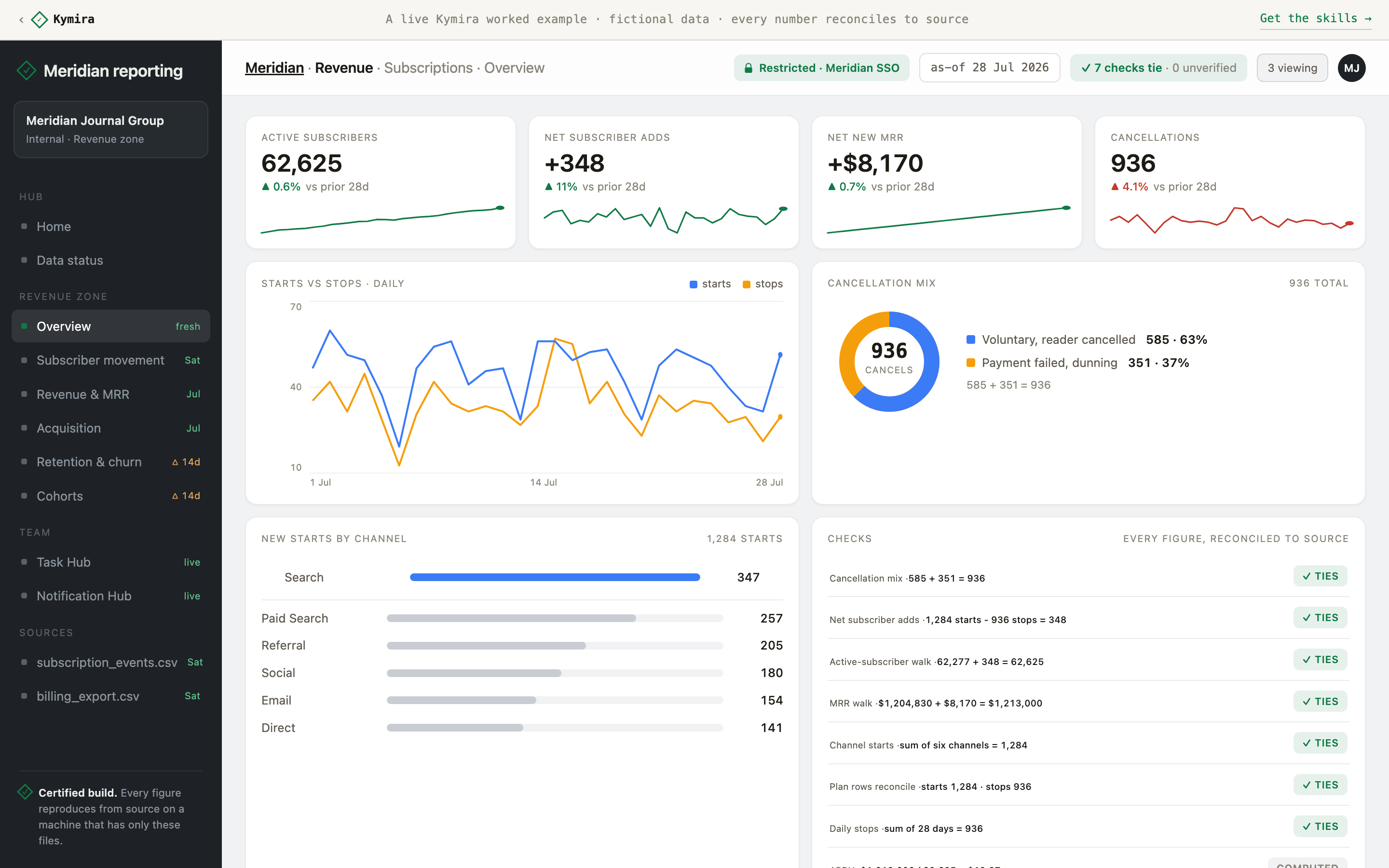
The live demo: the Overview report, where every figure reconciles to the source file's own totals and every check ties.
The live demo, as it runs: a certified report where every figure ties to the source file's own totals. Open the full intranet

Why it matters

Become the person who builds what the team runs on.

The real return on AI at work is you: shipping the dashboard leadership stops second-guessing, and the intranet the whole team works inside. Kymira gives your agent the judgment to build it right.

Build what used to need a team

A secure, certified BI intranet, built by you and an agent, this week instead of next quarter.

Be the one they trust

Every number reconciles to its source. Your work holds up the moment someone checks it.

Move faster than felt possible

The skills carry lessons a production build already paid for. The Monday deck ships on Monday.

Who this is for

Built for operators who own their numbers.

✓

You ship reports that executives act on, built from vendor exports and spreadsheets.

✓

You run Claude Code or Cursor, and you want numbers you can stake your name on.

✓

You have shipped, or nearly shipped, a wrong number. Checking now eats more of your week than building.

02What a skill isthe conversion gap

A skill is expertise your agent installs.

A folder of plain markdown your agent reads before it works, turning a clever first draft into a senior BI engineer that refuses to guess.

Drop the folder in · that is the install
~/.claude/skills/
  kymira-anchor-discovery/
    SKILL.md
    references/
  kymira-report-design/
    SKILL.md
  kymira-verification-practice/
    SKILL.md
  ... eighteen more
$ cp -r kymira ~/.claude/skills/
01

Install

Copy the folder into ~/.claude/skills/, or run the one-command installer. The kymira CLI handles install, status, and updates.

02

Describe

Ask for the report you need, in plain language. "Did the promotion work." "What we shipped versus what actually sold." It builds against your real exports.

03

Certify

Every figure traces to its source cell, and anything the file cannot prove is named on the page with the reason.

A model on its own

A clever first draft, confident everywhere.

  • Guesses a total when the file states none
  • Types a number the model composed itself
  • Presents every figure with equal confidence
  • Reads at a glance, ties to nothing

A model with the skills

A senior reviewer who shows the work.

  • Finds what the file asserts about itself
  • Reconciles every figure to that anchor, in code that re-runs
  • Catches any number it cannot prove, before it ships
  • Refuses to guess, out loud

The prompt you would write yourself

Always reconcile to the file's own totals. Never guess.

That sentence is the first line of the doctrine. The skills are the several hundred rules for what happens after it fails. Four it still ships:

  • A Total row that is also a data row, inflating every figure by exactly 100% while still reconciling against itself
  • A check that was structurally incapable of firing, showing green for weeks
  • A tolerance of 1.0 on a count, absorbing exactly the one dropped row an anchor exists to catch
  • Two churn definitions, both internally consistent, 3.4 points apart, each reconciling perfectly to its own source

You can write the sentence. The skills are everything it leaves out. Read the full doctrine

03The twenty-two skillsthe index

Twenty-two skills, in three registers.

Thirteen teach the craft. Seven make it a platform. Two make it yours: the secure intranet, and the co-pilot that stands it up.

✓ marks the tiers each skill ships in

Skill FreeF CoreC EverythingAll
Craftthirteen · the practitioner's judgment
01
Honest datavizCharts that read at a glance and survive a colour-blind reviewer; colour spent only on data.
✓✓✓
02
Report designThe report page that earns trust: honesty strip, check tracker, receipts that add up to their headline.
✓✓
03
Anchor discoveryFind what a file asserts about itself, then reconcile every figure to it. When nothing is asserted, refuse.
✓✓
04
Verification practiceEvery check is proven to catch a real mistake, not just tick a green box.
✓✓
05
Agent-era designThe design language: layered surfaces, ink chrome, typography that does not read as generated.
✓✓
06
Trust the uploadImmutable raw bytes, atomic state, staged publishes, ask do not guess. Each rule bought with a data-loss bug.
✓✓
07
Period & freshnessTell the period a report is about from the moment it was made; catch the wrong-period heading that passes every gate.
✓✓
08
Provenance & reproducibilityEvery number reproducible by a stranger: a content hash, a build commit, an exit-code contract.
✓✓
09
Adversarial reviewThe finders, skeptics and sabotage loop, made portable. A case that survives sabotage is the only case that counts.
✓✓
10
Contested metricsResolve the definition fork before computing; render the chosen one beside the number, or refuse.
✓✓
11
Hostile exportsMeet an unfamiliar vendor file and find its traps first: subtotal rows as data, payout not equal to revenue, silent unit drift.
✓✓
12
The glance testThe 20-second executive read, made correct: honesty strip up top, sample size travelling with its number.
✓✓
13
Workspace architectureYour project folder as a designed surface: the landing zone, names that route but never assert, and an agent that pulls fresh exports out of Downloads by itself.
✓✓
Platformseven · one file becomes a system
14
Interactive reportsDate pickers that default right, cross-filtering, drill to the rows behind any number; checks recompute on every filter.
✓
15
Certified exportsCSV, Excel and PDF from the same build as the page; Excel totals as live formulas, round-trip verified.
✓
16
Delivery & alertsReports that arrive: email and Slack on refresh, thresholds as config. An alert never fires on a number that is not verified.
✓
17
Interactive mapsVector-only maps, one projector, every location that fails to geocode printed. The map reconciles like every surface.
✓
18
Deck exportThe Monday deck without the screenshots: charts land in PowerPoint from the same build, provenance on every slide.
✓
19
AnnotationsEvent markers as data, team notes append-only. An annotation never changes a number.
✓
20
The metric storeDefine churn once: the chosen fork, formula and anchor in one versioned file the agent consults before computing.
✓
The intranettwo · the superpower
21
Secure intranetEvery report in one place on Cloudflare, behind a default-deny wall, refreshed by dropping a file, with live shared team state.
✓
22
Intranet co-pilotThe guide from a folder of exports to a live URL: the end-state map, the build order, the engine-vs-config split, and the Cloudflare account, token and provisioning walkthrough, all sequenced.
✓

✓ Everything · the superpower

One report is a file. This makes it a platform.

Every report lands in one place on Cloudflare, behind a default-deny wall. Refresh a dashboard by dropping in a new export. A live team layer on top: task board, notification hub, shared flags and rulings. And the co-pilot takes you from a folder of exports to the live URL, end to end.

See stage 3 of the quick start →
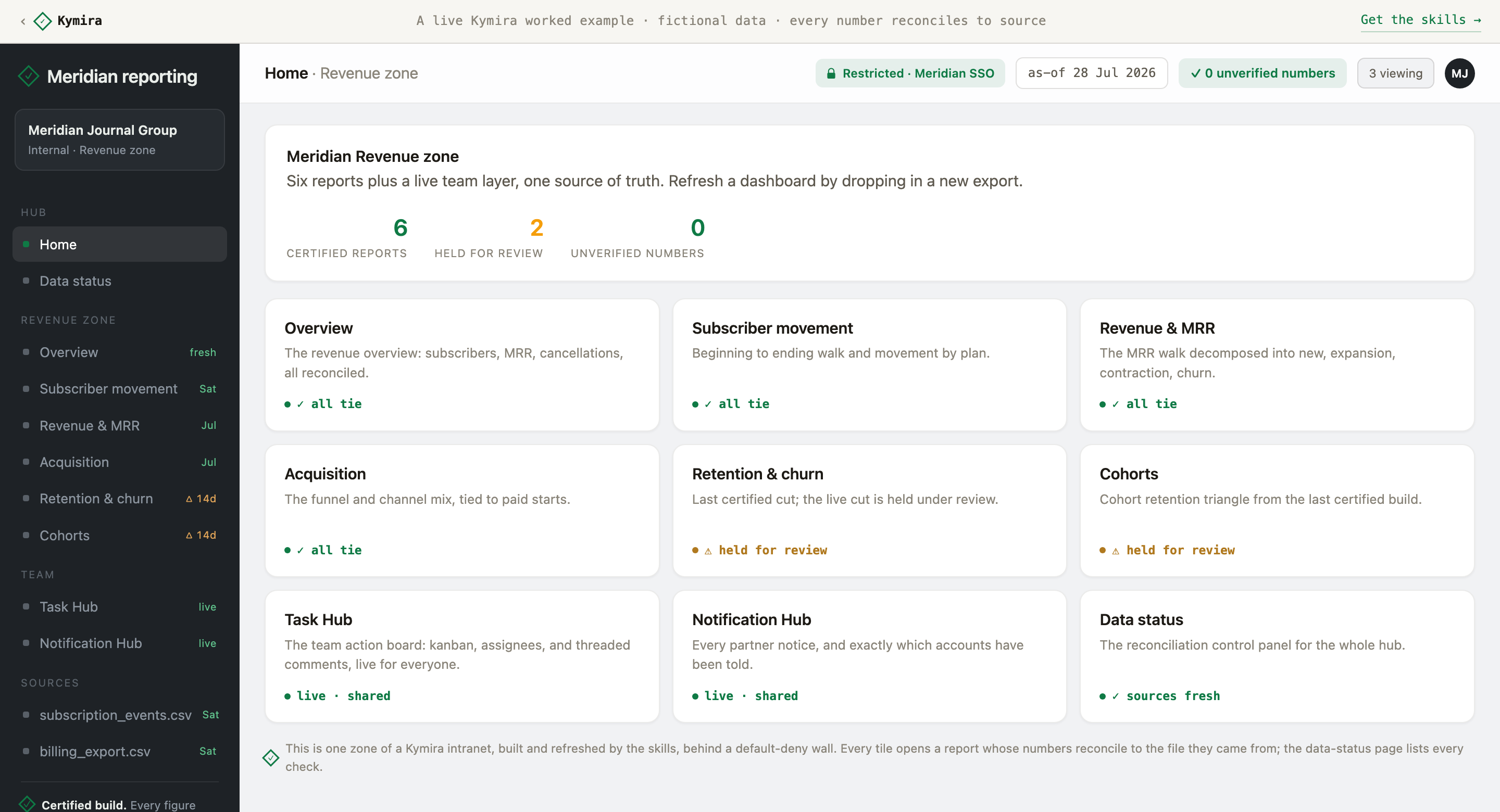
The live demo intranet hub: six certified reports, the Task Hub and Notification Hub, and a data-status page, behind a default-deny wall.
04The rigor behind itthe receipts

Verified by construction.

When the number in the meeting is yours, you carry the miss. These skills were hardened inside a real reporting system until every number it published reconciled to its source. Your agent applies those lessons from the first report.

105
real mistakes caught and fixed while building the system these skills come from
216
automatic checks that stand between your data and a wrong number on the page
351
metric definitions across twelve departments, the arguments already settledthe Metric Library
47
messy vendor export shapes mapped, with the trap in each one namedthe Format Library

Built, broken on purpose across thirteen audit rounds, and rebuilt until every number it published reconciled to its source. Every rule you get was paid for in that build.

Reconciliation runs as code your agent re-runs on every build. A figure the file cannot prove is named on the page with the reason. Every number traces back to the rows that produced it.

One specimen · the Metric Library

Net Revenue Retention NRR

How much recurring revenue this year's cohort of existing customers grew or shrank to, counting their upsells, downgrades, and cancellations, but not any brand new customers.

The fork, why two teams get different numbers

The single most gamed SaaS metric, and the forks live in the denominator and the window. The cohort fork: NRR must measure only the customers present at the start, yet the common error is ending total MRR over starting total MRR, which sneaks new customer revenue into a retention number. The window fork: a trailing twelve month cohort figure versus a single strong month annualized. Investors read the trailing figure, internal dashboards often show the annualized one, and they rarely match.

The trap

The denominator swap. A company adding logos fast can show 130% NRR while its actual cohort is shrinking, a growth rate wearing a retention label.

One of 351 metric definitions, each with its fork and its trap. Everything includes the Metric Library
05The failure catalogueobserved, never hypothetical

Why raw AI outputs aren't boardroom ready.

Below are all the ways AI models fail when building reporting dashboards. Kymira is built to address every single one. How? Each entry is a real failure mode, discovered and resolved while building Kymira. Training your own Claude Code or Cursor instance to overcome this list would take upwards of 40 hours of tedious trial and error.

The number is plausible, and wrongeight · passes every arithmetic check
01
The 100x slip that ties perfectly. A fat-fingered price multiplies through every subtotal; every reconciliation passes, the headline triples.
02
The quantity slip. Screens tuned to prices sail past a 100x seats error that certifies just as cleanly.
03
The total that repeats on every line. Sum the obvious CRM column and revenue lands at a multiple of the truth; we measured 9x.
04
The Total row that is also data. The file's own summary row gets summed along with its rows, doubling the answer.
05
The lift a holiday window tripled. The comparison window quietly absorbed a holiday; the headline was three times its true size.
06
The trend that was one purchase order. A whole 6x story traced to a single large order; the real figure was 1.8x.
07
Phantom margin from one bad cost line. One corrupted value manufactured a category's entire margin swing.
08
The wrong column that reconciles. Right shape, wrong meaning, and every total still ties.
The file liesnine · named by the system, not for you
09
The filename that lies about the period. A file called Q2 carrying July rows.
10
The date that parses two valid ways. 4/9/2026 is April or September depending on an unstated locale; both parses succeed.
11
Two date formats in one column. ISO and US dates interleaved, parsing cleanly into silently mixed months.
12
The encoding that crashes the pipeline. A non-UTF-8 export that kills the reader mid-run, or worse, half-parses.
13
Names doing the work of keys. Two accounts with one name silently merge, and their history becomes fiction.
14
The substring that misfiles a customer. A surname containing a retailer's name lands an account in the wrong channel.
15
Products living only in free text. Extraction rules grow into dozens of patterns nobody audits.
16
The join that quietly covers 62%. A third of rows dropped by a reference join, and nothing said so.
17
The platform grading its own homework. Ad platforms summing to more revenue than the business made.
The metric means something elseeight · consistent, reconciled, and misread
18
Two churn definitions, 3.4 points apart. Two teams, one word, different denominators, one deck mixing them.
19
Sell-through's four denominators. Four numbers, one name, and a marketplace variant above 100%.
20
Gross, net, and total from one admin. Three revenues from a single backend before accounting adds theirs.
21
Lift as a multiple or a percent. One toolset's 1.4 is another's 40; no notation warns you.
22
The calendar fork. 4-5-4, 4-4-5, or thirteen periods, silent in the data.
23
Two honest headlines from one file. Quarter grain or month grain yields figures five times apart from the same rows.
24
The definition that drifted between copies. One reference table pasted into three scripts, updated in two.
25
The average of incomparables. Two retailers' different definitions averaged into a number that describes nothing.
The verification is theaterseventeen · it does not miss errors, it manufactures confidence
26
The verify script that silently did nothing. The agent's own checks passed while checking nothing; the numbers were headed for a deck.
27
The check that cannot fail. Literally pass-if-true, rendered green on four surfaces beside real gates.
28
The painted row. Verdict text hardcoded while the scan's actual findings were computed and discarded.
29
Fire-test theater. The test re-implements the guard and stays green forever while the deployed guard is broken.
30
Borrowed evidence. Two checks pointing at the same fire-test log, proving neither.
31
Both rails from one blueprint. An independent double-read that compared 537 values to themselves. Agreement guaranteed, meaning zero.
32
The tolerance that ate the error. Two reads disagreed, so the tolerance grew until they did not.
33
The screen calibrated by its own target. An outlier ceiling derived from the data being screened; the slip becomes its own ceiling.
34
Detection without disclosure. The check table counts the flag; the certified page shows the figure clean.
35
The tie that compared revenue to seats. A green mark asserting agreement between numbers that measure different things.
36
The gate that certified the leak. A round-trip check blessing a PDF with the build machine's temp path on every page.
37
The hash that disproves itself. A text-mode sha256 failing the customer's first integrity check.
38
The stale fingerprint. An index page showing truncated hashes from an earlier cut of the files beside it.
39
The fix that landed on the letter. The cited mechanism gets repaired and the harm it exists to prevent still lands, so the rule now reads as satisfied.
40
The check that reads its own configuration. Red-capable, evidence-backed, and blind: its verdict comes from a config flag the same build just set to true.
41
The check that proves a coincidence. Built from literals true of one file. Move a row between regions and it blocks a correct build.
42
The honest refusal that catches nothing. A screen that declines to calibrate everywhere reads as diligence and leaves the column unscreened.
The wrapper betrays the numbersnine · perfect figures, dead on first forward
43
The certified page that opens as garbage. No charset declaration; every heading renders as mojibake for the recipient.
44
The board pack that names your temp folder. Print chrome stamping the build timestamp and a local path across all 25 pages.
45
The manifest that contradicts its page. Hand-typed counts disagreeing with the machine output beside them: says 3, shows 6.
46
The stack trace deliverable. One bad date, a raw exception, zero artifacts, 537 rows of provable verdicts discarded.
47
The rerun that trampled the good pack. A failed build writing over the last known-good deliverable, file by file.
48
The refresh time bomb. The window's end date hardcoded in five places; next month's run is silently last month's.
49
The step nobody can run again. The first transformation done interactively and never preserved; no number reproducible.
50
The estimate outside its own interval. Two code paths, two exclusion rules, and every headline KPI outside its own confidence interval.
51
The blocked run that ate the good pack. The failure handler deleted the last known-good deliverable while the page beside it said it was untouched.
✓Kymira closes all fifty-one. The eleven-principle doctrine, the twenty-two skills below, and a mechanical gate that fails a build rather than let one through. Read the full catalogue, with the closure cited for every entry.
06Pricingown it, do not rent it

Own it. Don't rent it.

Priced for the operator, not the procurement cycle. Every paid tier is a one-time purchase with lifetime updates: no seats, no subscription, no lock-in. No demo call and no waiting for the org to sign: install it and trust your numbers today.

Honest dataviz
$0
Free forever
  • The dataviz skill, complete
  • The doctrine, all eleven principles
  • The install guide, running in minutes
  • Available now on GitHub, no email needed
Get the free skill
Core pack
$199
One-time · lifetime updates
  • The thirteen craft skills, versioned
  • Worked examples in every skill, each rule shown catching the real mistake it exists for
  • The one-command installer and the kymira CLI: install, status, update
  • Upgrade to Everything later; you pay the difference, not twice
Get the pack
Everything
$349
One-time · lifetime updates
  • All twenty-two skills + the template bank
  • The Metric Library, 351 definitions, every fork worked
  • The Format Library, 47 export shapes, every trap named
  • The installer and the kymira CLI included
  • Personal license
Get everything
Built for you
Custom
By application
  • A working consult with the engineer behind the engine
  • A custom verified BI site on your real exports
  • Everything license and team training included
Start a conversation

Core teaches your agent to build one report you can trust. Everything turns reporting into a system: the platform skills, the intranet, and both libraries.

The files are plain text with no copy protection. Read them, edit them, keep them. One purchase, lifetime updates: every new version and addition to the skills and libraries in your tier, at no new cost. Kymira is an active development project; the roadmap is public. The free skill is the trial: all sales are final.

In build: the hosted tool. Upload a raw export, get an audited report site, no agent required. Join the waitlist.

07Questionsthe short answers

The short answers.

What is Kymira?

Installable skills and two reference libraries for the agent you already run, Claude Code or Cursor. They teach it to turn raw exports into business intelligence where every number reconciles to the file's own totals, and anything it cannot prove is caught before it ships.

How is this different from Datarails, Cube, or Vena?

Those are enterprise FP&A platforms: quote-based, demo-gated, bought by the finance organization on annual contracts. Kymira is the certified-numbers layer for the operator: $349 once, installed into the Claude Code or Cursor you already run, producing verified reports the same day. See the comparison.

What do the skills actually do?

Each skill is a plain markdown playbook your agent reads before it builds a report: find what a file asserts about itself, reconcile every figure to it, resolve the metric definitions teams disagree on, and design a dashboard that reads at a glance. Plus the skills that turn your reports into a secure internal platform, with maps, exports, delivery, alerts, decks, annotations, and the metric store. Twenty-two skills in all. For what this is actually like, day by day, read your first week.

How do I install a skill?

Copy the skill's folder into your agent's skills directory, ~/.claude/skills/ for Claude Code, or the generated AGENTS.md rule for other agents, and start a fresh session. There is no build step, a skill is just files. Paid packs also ship the kymira CLI: one command to install, check status, and pull updates.

What is in the Metric and Format libraries?

The Metric Library has 351 metric definitions across twelve departments, each naming the competing definitions teams argue over (the fork) and how the number lies in real exports (the trap). The Format Library maps 47 vendor export shapes, Stripe, QuickBooks, Shopify, Salesforce, GA4 and more, with the structural traps in each and the anchor that reconciles it.

Do I own the skills, or is it a subscription?

You own them. Every paid tier is a one-time purchase with lifetime updates, no subscription. The files are plain text with no copy protection: read them, edit them, keep them.

Can you build it for me?

Yes. Built for you is a founder-led engagement: the engineer behind the engine builds a custom, certified BI site on your real exports. It is by application, priced on the scope.

Where does my data go?

Nowhere. The skills are static text files that run inside your own agent, on your machine; Kymira has no server that ever sees your exports, and the files contain no telemetry. The only network calls in the product are the optional installer checking your license key and the optional kymira update command fetching new skill versions; neither ever transmits your data. The full security model is at kymira.ai/security.

Couldn't I just prompt this myself?

You can write the sentence: always reconcile to the file's own totals, never guess. The skills are the several hundred rules for what happens after that sentence fails: the Total row that is also a data row, the check that cannot fire, the tolerance that absorbs the exact error it exists to catch. Each rule was paid for by a real wrong number, which is precisely why a one-line prompt does not contain it.

Won't a better model make this unnecessary?

The guarantees here are process, not model behavior: reconciliation runs as code your agent writes and re-runs, and gates that fail closed cannot be talked out of by a smarter model, because they are not requests to the model. And most of the content is facts about vendor files and your own definitions, which no model upgrade supplies: a better model still does not know which churn definition your CFO ruled on. When models change, lifetime updates cover the port.

What if a pack is not for me?

All sales are final, because the files are plain text you keep the moment they arrive. The free skill and the full doctrine cost nothing, so judge the quality there first; each tier card states exactly what the pack contains. Billing errors and failed deliveries are always put right.

Does it work with Cursor and other agents?

Yes. Every skill ships in four formats: the Claude Code skill folder, a Cursor rule file for .cursor/rules/, an AGENTS.md variant, and a plain prompt for any other agent. The install guide covers each.

Can I upgrade from Core to Everything later?

Yes. Upgrading is the same motion as updating: get the Everything pack and re-run the installer, which replaces the Core pack cleanly. Write to the support address for the upgrade price; you pay the difference, not twice.

Is there a version that does not need a coding agent?

In build: the self-serve hosted tool, where you upload a raw export and get an audited, certified report site with no install and no agent. The skills are the engine behind it. Join the waitlist to be first in line.